Renewable Energy
Who Owns Clean Power? What 300,000 Patent Families Reveal About the Renewables Race
Key findings
- Renewables patent filings grew about 2.6 times between 2015 and 2023, to about 45,000 families a year. Hydrogen (about 6 times) and recycling (about 5 times) grew fastest; solar, still the largest area, grew slowest (about 1.9 times).
- Invention is shifting to what makes renewables dependable. Storage and grid integration are still accelerating, and both reached their highest levels in 2024.
- Volume is not reach. Only about one renewables family in ten is protected in Europe, half the share for EVs. The largest filers in grid and storage, led by State Grid, hold almost none of it.
- Europe leads where it protects. Vestas, Siemens Gamesa, Enercon and Nordex dominate wind in Europe, and European companies hold six of the top ten positions in hydrogen, the most Europe-protected area (14%).
- Recycling is Europe’s gap and its opening. Only about 6% of recycling families are protected in Europe, but most of those belong to European companies and start-ups, unlike EV battery recycling.
Clean power still has a materials problem
A solar panel or a wind turbine produces no emissions while it runs, so renewable power is easy to treat as clean by definition. The full picture is more complicated. Panels, turbines, batteries and electrolysers carry a manufacturing footprint, depend on supply chains concentrated in a few countries, and become waste at the end of their life.
The reasons for building them have also shifted. The IEA now says energy security, rather than climate policy alone, is the main driver of renewables growth, as countries try to cut their exposure to imported fuels after the oil and gas shock of 2026. That puts a sharper question on the table: who owns the technology the world is now racing to build?
Patent filings are one of the earliest places to see the answer. This article follows them across six technology areas, from solar cells to recycling, to show where invention is concentrated, who holds protection in Europe, and what it means for companies building, supplying or advising in clean energy.
The numbers in brief
The world added a record 692 GW of renewable capacity in 2025, lifting the total to 5,149 GW, according to IRENA. Solar alone added 511 GW, about three-quarters of the total, and wind added 159 GW. Renewables now make up just under half of all installed power capacity worldwide.
Growth is set to continue. The IEA expects almost 4,800 GW of new renewable capacity between 2026 and 2031, 57% more than in the previous six years, with India becoming the second-largest market after China.
Europe is growing, but more slowly. It has 934 GW installed, second only to Asia, and is expected to add around 100 GW a year to 2031. But the IEA cut its European forecast by 6% this year, noting that higher power prices have not yet led to faster installations.
Manufacturing is even more concentrated than deployment. China supplied about 80% of global solar module demand and 90% of wafers and polysilicon in 2024. In October 2026 it went further, proposing export restrictions on 12 solar manufacturing technologies, including processes for perovskite and tandem cells. Who owns renewable technology is now a matter of trade policy, not just competition.
Why sustainability is now an engineering problem
Three pressures sit behind most of the innovation in renewable energy.
The manufacturing footprint. A panel’s emissions are front-loaded into its production, and most panels are made in China, where coal still generated close to half of all electricity in the first half of 2026, according to Ember. Thinner wafers, less energy-hungry cell processes and higher-efficiency designs such as tandem cells all reduce the carbon cost of each watt.
Critical materials. Solar cells depend on silver for their contacts, many offshore wind turbines use rare-earth permanent magnets in their generators, and PEM electrolysers for green hydrogen rely on iridium and platinum. China refines around 85% of the rare earths used in magnets, according to the IEA. Designs that use less of these materials, or none, respond directly to that risk.
End of life. The first large generation of panels and turbines is now ageing out. IRENA expects the EU’s annual volume of end-of-life solar panels to pass one million tonnes around 2040 and 2.2 million tonnes by 2050. For wind, WindEurope expects decommissioned blade material in Europe to rise from about 20,000 tonnes in 2025 to 55,000 tonnes a year by 2030, and many blades are not yet recycled.
Where the innovation is happening: six technology battlegrounds
Renewables patent filings grew about 2.6 times between 2015 and 2023, from about 17,200 to 45,000 families a year, and 2024 is already higher still. Growth has been uneven: solar, the largest area, grew slowest, while hydrogen and recycling grew fastest.
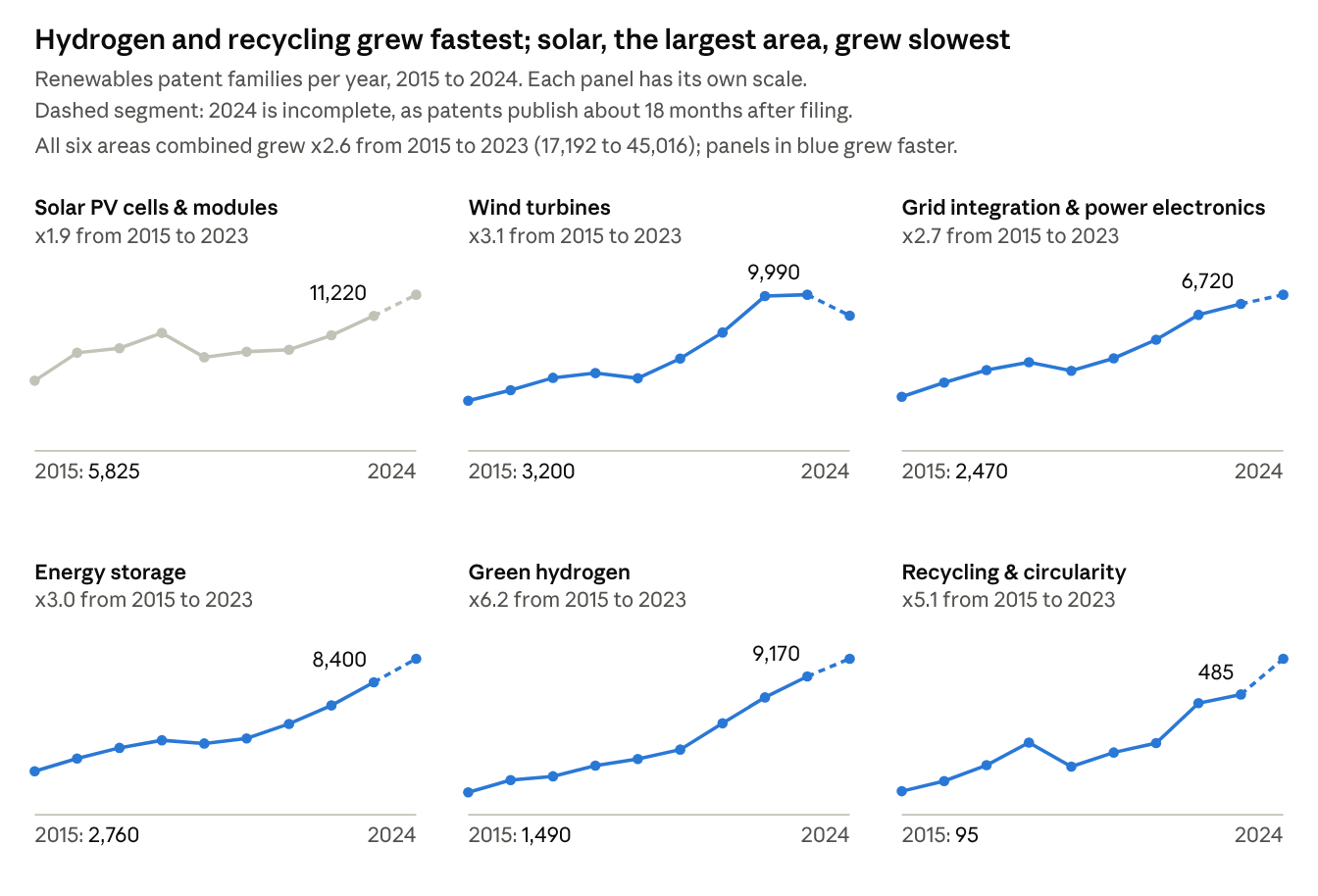
Questel Orbit Intelligence (FamPat) · patent families by earliest priority year, utility-model-only families excluded · total exact, individual areas read from Orbit charts (approximate)
Solar PV cells and modules. Still the largest area, at about 11,000 families a year, but it grew only about 1.9 times, and its share of all renewables filings fell from 34% in 2015 to 25% in 2023. Filings have picked up since 2021, and 2024 is already the highest year. Much of the activity is in perovskite, tandem and heterojunction cells, which get more power from each wafer.
Wind turbines. Filings grew about three times, with the steepest rise between 2020 and 2022, then levelled off. 2024 is lower, though its data is incomplete.
Grid integration and power electronics. Filings grew 2.7 times and are still rising, with 2024 already the highest year. As renewables take a larger share of supply, connecting them to the grid has become a bottleneck in its own right.
Energy storage. About three times growth, and still accelerating: filings have risen by about 1,200 to 1,500 a year since 2021, and 2024 is about 18% above 2023 despite incomplete data. Storage is what makes solar and wind power available when it is needed.
Green hydrogen. The fastest-growing large area, about six times more filings in 2023 than in 2015, and the only one that grew every year. Filings jumped by about 40% in 2021, and hydrogen is now the second-largest area after solar.
Recycling and circularity. The smallest area, at about 500 families in 2023, but it grew about five times, and 2024 is already higher. Most filings cover dismantling solar panels and recovering silicon, silver and glass.
How we counted: patent families (one family is one invention, however many countries it is filed in) with an earliest priority date from 2015 to 2024, from Questel Orbit Intelligence (FamPat). Families protected only by utility models and business-method patents are excluded, as are image sensors and display materials that share classification codes with solar cells. The six areas overlap by about 3%, so they do not add up exactly to the total. 2024 is incomplete because patents publish about 18 months after filing.
Who’s leading: top filers and surprising entrants
The largest holders of renewables patent protection in Europe are wind turbine makers: Vestas (about 1,040 families), Siemens Gamesa (about 865) and Enercon (about 480), followed by Bosch (about 475), Huawei Digital Power (about 460) and the French research agency CEA (about 430). Seven of the ten largest holders are European, and together the top ten hold 17% of all Europe-protected families.
The picture changes sharply by technology:
| ITechnology area | Largest filer worldwide | Largest holder in Europe | European companies in Europe's top 10 |
|---|---|---|---|
| Solar PV cells and modules | Jinko Solar (~1,205) | CEA (~265) | CEA, Fraunhofer |
| Wind turbines | Goldwind (~1,410) | Vestas (~895) | Vestas, Siemens Gamesa, Enercon, Nordex, ZF |
| Grid integration and power electronics | State Grid group (~7,800) | Huawei Digital Power (~242) | Vestas, Enercon, Hitachi Energy, SMA, ABB |
| Energy storage | State Grid group (~4,570) | Huawei Digital Power (~197) | Hitachi Energy, Bosch, CEA |
| Green hydrogen | Toyota (~530) | Bosch (~405) | Bosch, Siemens Energy, Air Liquide, CEA, Linde, Topsoe |
| Recycling and circularity | TPRI (~34) | Siemens Gamesa (~8) | Siemens Gamesa, Vestas, CEA, ROSI, Flender |
Volume is not the same as reach. State Grid and its subsidiaries hold about 17% of all grid integration families worldwide, the largest share of any company in any area, yet none of them appear in Europe’s top ten for grid or storage. Goldwind is the largest wind filer worldwide but holds about 110 Europe-protected families, against about 895 for Vestas. In hydrogen, six Chinese organisations are in the global top ten, but none are in Europe’s.
Who leads depends on the technology. In wind, European turbine makers and GE hold almost all the top positions. In hydrogen, the race in Europe is between European industrials (Bosch, Siemens Energy, Air Liquide, Linde, Topsoe) and Japanese groups (Toyota, Toshiba, Mitsubishi Heavy Industries, Kawasaki). In solar, Europe’s protection sits with research institutes such as CEA and Fraunhofer, alongside Chinese manufacturers that export modules to Europe (Jinko, Trina, LONGi). In grid and storage, the holders are equipment makers that sell into Europe, such as Huawei Digital Power, Sungrow, CATL and LG Energy Solution, rather than grid operators.
Surprising entrants. Huawei Digital Power, the energy arm of the telecoms company, is the largest holder in Europe for both grid integration and storage, and it was also among the leading holders of EV power electronics protection in the previous article in this series. CATL, the world’s largest EV battery maker, holds about 105 Europe-protected solar families, mostly perovskite cells. In recycling, start-ups such as ROSI (France) and SolarCycle (US) sit alongside Siemens Gamesa and Vestas.
Company groups are combined where Orbit lists them separately: Jinko Solar (two entities), Goldwind (two), State Grid group (State Grid Corporation of China, its provincial subsidiaries and the China Electric Power Research Institute) and GE (GE Renewables, LM Wind Power, GE Infrastructure Technology, GE Vernova). Figures are approximate, read from Orbit charts.
The geographic picture: Europe, China, US, Japan and Korea, India
China files the most renewables patents by far, but only about one family in ten (9.6%) has live protection in Europe, roughly half the share we found for electric vehicles. That share varies widely by technology.
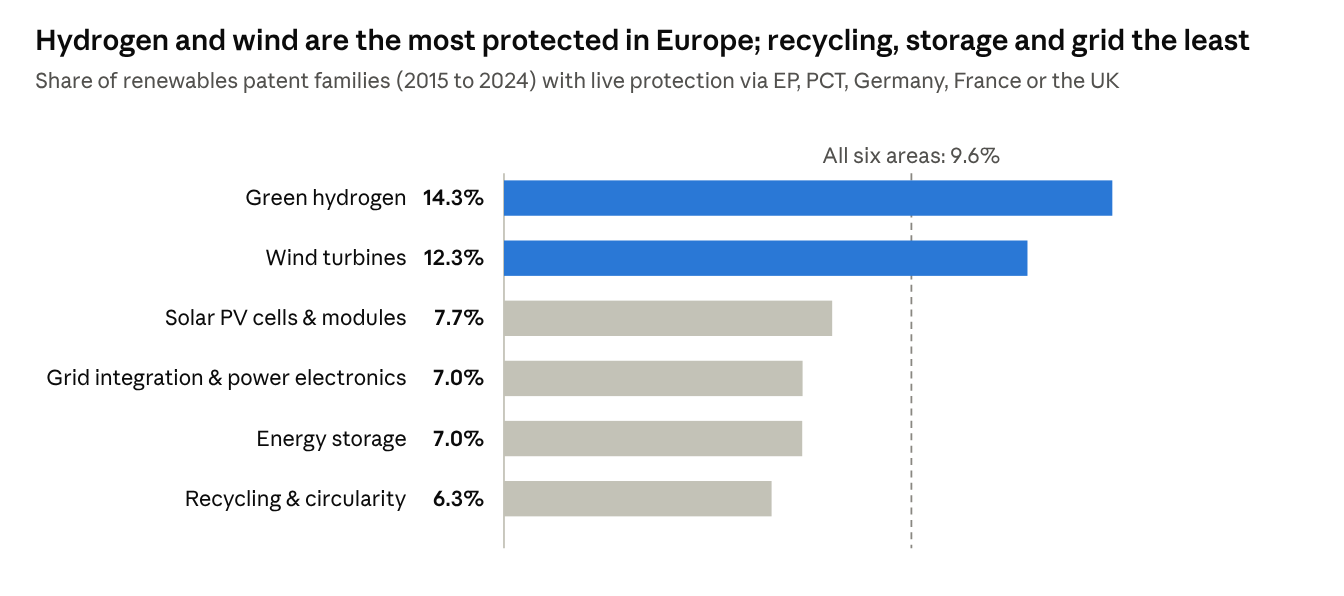
Questel Orbit Intelligence (FamPat) · patent families with earliest priority 2015–2024, utility-model-only families excluded · counts from Orbit search results
China leads on volume. Chinese filings are the largest group in every one of the six areas, but most of them are never extended abroad.
Europe’s protection runs mainly through the EPO. Of the roughly 29,000 renewables families protected in Europe, about 24,100 (83%) include a European Patent Office application, and roughly half are protected in Germany. That differs from the EV article, where German national filings carried much of the weight. For renewables, watching EP filings captures most of the competitive picture.
Why the shares differ. Hydrogen and wind sit above the average because their leading companies, from Vestas and Siemens Gamesa to Bosch and Siemens Energy, sell turbines and electrolysers across borders and protect them where they sell. Grid integration, storage and recycling sit below it: their largest filers worldwide are Chinese grid operators, universities and research institutes working mainly for their home market.
Korea and India. Korea is an important second market in solar, helped by Hanwha Q Cells, and in recycling, where several Korean firms specialise in panel dismantling. India appears among the top ten markets in most areas, but at small volumes.
“Live protection in Europe” means a granted patent or pending application, at the time of the search, at the European Patent Office, in Germany, France or the UK, or a pending PCT application.
Regulation as an innovation driver
EU rules now shape not just how much renewable capacity Europe installs, but where the equipment is made and what happens to it afterwards.
Renewable Energy Directive. The revised directive sets a binding target of at least 42.5% renewables in EU energy consumption by 2030. The Commission’s 2025 assessment of national plans pointed to about 41%, and only Denmark had transposed the directive by its May 2025 deadline, so pressure to deploy faster will continue through the decade.
Net-Zero Industry Act. Adopted in 2024, it sets a benchmark for EU factories to meet at least 40% of the EU’s annual needs for strategic clean technologies by 2030, including solar PV, wind, batteries, electrolysers and grid components, and a 15% share of global clean-tech manufacturing by 2040. Building that capacity in Europe means building, licensing or buying the technology behind it.
Hydrogen targets. REPowerEU set an ambition of 10 million tonnes of domestic renewable hydrogen plus 10 million tonnes of imports by 2030. Deployment is far behind: the EU had only about 308 MW of electrolysers installed by the end of 2024, against a target of 40 GW by 2030, according to the EU energy regulators’ agency ACER.
End-of-life rules. Solar panels have been covered by the EU’s WEEE Directive since August 2012, which makes producers responsible for financing their collection and recycling. For wind blades there is no EU-wide rule; instead, the European wind industry has committed to a voluntary landfill ban from 1 January 2026.
Do the rules show up in patents? Hydrogen filings jumped by about 40% in 2021, the year after the EU published its hydrogen strategy, and hydrogen is now the most Europe-protected area in this analysis (14%). Recycling tells the opposite story: despite producer responsibility for solar panels since 2012, only about 6% of recycling families are protected in Europe. Rules can create demand, but they do not by themselves build a European patent position.
What this means for companies in the space
Manufacturing in Europe means owning or licensing the technology. The Net-Zero Industry Act pushes production back into Europe, but in solar most manufacturing know-how now sits in China, which is moving to restrict its export. Companies planning European capacity need a clear view of who holds the relevant patents, and where.
Hydrogen is still open ground. The top ten filers hold only 7% of hydrogen families worldwide, the most fragmented of the large areas. European industrials lead in Europe, with Japanese groups close behind. In a field where ownership is still being settled, early and well-drafted filings carry more weight than in mature ones.
Recycling is an obligation and an opening. Producers already pay for solar panel recycling in Europe, and waste volumes will rise sharply in the 2030s and 2040s. With little recycling IP protected in Europe so far, recyclers, manufacturers and materials companies still have room to build a position early.
Watch the companies that sell in Europe, and expect challenges in wind. The biggest filers in grid and storage rarely protect in Europe, but equipment makers such as Huawei Digital Power and Sungrow do, and they are the ones a European competitor will meet. In wind, about 12% of Europe-protected families have faced an opposition at the EPO, by far the highest rate in this analysis, so freedom-to-operate work and opposition readiness matter as much as filing.
Generation is the final link in the chain
This series has followed electricity from three directions. AI data centres are driving a new wave of demand for power and cooling. Electric vehicles store and move that power, and are starting to feed it back to the grid. Renewables generate it.
The same questions run through all three: who owns the key technologies, where they are protected, and whether Europe is building its own position or depending on others. Renewables add one more: the race to deploy is now also a race to manufacture, and the technology needed to manufacture is increasingly treated as strategic.
The patent record gives a clear answer for Europe: it is a leader in wind, a strong contender in hydrogen, and an early holder in recycling, but most of the invention in solar, storage and the grid is happening, and staying, in China.
Sources
- Patent data: Questel Orbit Intelligence (FamPat), searches run November 2026; six technology clusters, their combined total, and Europe protection sets
- IRENA, Renewable Capacity Statistics 2026 (via WAM) (April 2026)
- IRENA, Renewable Capacity Statistics 2026, regional figures (via MyJoyOnline) (April 2026)
- IEA, Renewables 2026 (via Engineering News) (November 2026)
- IEA, Renewables 2026, India as second-largest market (via GreentechLead) (November 2026)
- EUobserver, From India to Africa, renewables race ahead but Europe is lagging (November 2026)
- IEA, Energy Technology Perspectives 2026: manufacturing and trade (2026)
- Business Standard, China proposes ban on export of 12 solar manufacturing technologies (October 2026)
- Climate Home News, China’s industrial engine starts to break its fossil fuel habit (on Ember’s China Energy Transition Review 2026) (September 2026)
- Bank of Finland BOFIT, on IEA Global Critical Minerals Outlook 2026 (August 2026)
- oEnergetice, panel recycling will be a key challenge (on IRENA, July 2026) (August 2026)
- WindEurope, Where do wind turbine blades go when they are decommissioned? (November 2025)
- Enerdata, EU member states and RED III transposition (2025)
- Herbert Smith Freehills Kramer, Net-Zero Industry Act implementing rules (2025)
- Hydrogen Fuel News, EU hydrogen targets (October 2026)
- Hydrogen Fuel News, on ACER’s 2025 European Hydrogen Markets Monitoring Report (December 2025)
- oEnergetice, hydrogen deployment in the EU falls far short of expectations (December 2025)
- EUR-Lex, Directive (EU) 2024/884 amending the WEEE Directive (legal text)