
Data Centres
Power Is the New Bottleneck: What Patents Reveal About the Race to Run AI Data Centres
AI’s real constraint isn’t compute. It’s power.
Microsoft, Alphabet, Amazon and Meta spent about $410 billion on capital expenditure in 2025. Their plans for 2026 add up to roughly $725 billion, an increase of 77% in a single year (Yahoo Finance). Most of that money is going into AI infrastructure: chips, servers, and the buildings that house them. Electricity use in AI-focused data centres grew by 50% in 2025 alone (IEA).
For three years, the AI story has been told through chips: who has the GPUs, who is waiting, and what they cost. That story is still true, but it is no longer the whole story.
Ask anyone planning a large data centre today what slows them down, and the answer is increasingly the grid connection, not the hardware order. A new AI campus can be built in eighteen months. Bringing several hundred megawatts of reliable power to the site can take far longer. Once the power arrives, the servers turn almost all of it into heat that has to be removed, rack by rack, around the clock.
Power in and heat out. These two problems now decide where AI capacity gets built, how fast, and at what cost. They are also where some of the most active engineering of this decade is happening, and the patent record shows it clearly.
The numbers in brief
Data centres used about 485 TWh of electricity worldwide in 2025, up 17% in a single year, against 3% growth in overall electricity demand (IEA). That is still only around 1.5% of global electricity. The concern is not the share but the speed, and how concentrated the demand is.
The United States accounts for about 45% of global data centre consumption, China for about 25% and Europe for about 15% (IEA). In the US alone, data centres used 192 TWh in 2024, or 4.7% of national electricity, more than three times the 58 TWh of a decade earlier (LBNL).
These are projections, and they move with every new forecast. But every major estimate points the same way: data centre electricity demand roughly doubles by 2030, and AI drives most of the increase.
Why AI changes the equation: density, heat and the limits of air
The problem is not just that AI data centres use more power. It is that they pack that power into a much smaller space.
The typical rack in a conventional data centre still draws about 11 kW. A single rack of Nvidia’s GB300 NVL72 needs up to 142 kW (Data Center Knowledge). Next-generation platforms are expected to pass 200 kW per rack, and Google has shown a design for a 1 MW rack (Jabil).
That density breaks two things data centres took for granted for decades.
The first is cooling. Air stops being practical at around 50 kW per rack, because fans cannot move enough of it through the equipment (Data Center Knowledge). Above that, heat has to be carried away by liquid, through cold plates mounted on the chips or by submerging the hardware in a dielectric fluid.
The second is power delivery inside the building. The low-voltage DC distribution used in most racks today runs into physical limits at around 200 kW, where the copper needed to carry the current becomes too heavy and bulky (Data Center Knowledge). The industry is moving to higher-voltage architectures and new power conversion stages.
Neither is a minor upgrade. When an industry has to redesign its physical infrastructure this quickly, the inventions show up in patent filings before they show up in product brochures.
What the patent record shows
We analysed patent filings in three areas where AI is forcing new engineering: liquid cooling, thermal management, and power delivery and backup. Together they account for about 10,500 patent families filed between 2015 and 2024, and annual filings grew five-fold, from about 420 to about 2,100. The acceleration starts in 2020 and has not slowed since.
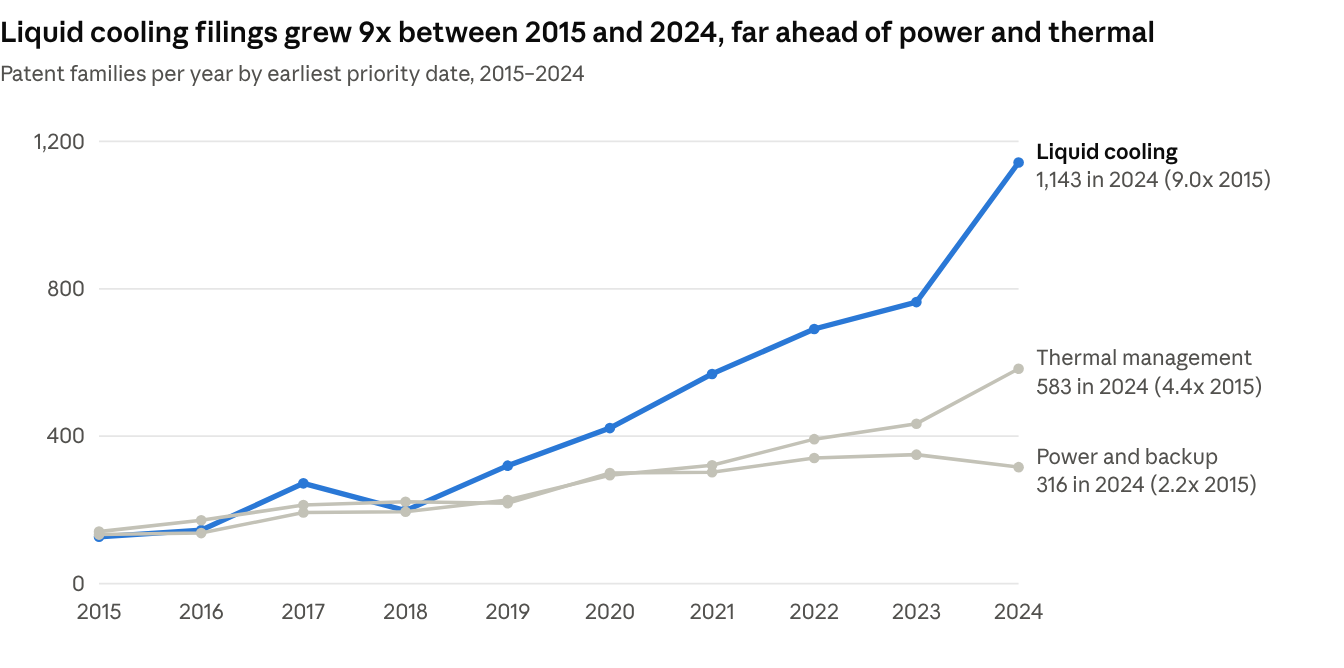
Epiphany IP analysis of Questel Orbit (FamPat) data · patent families by earliest priority year · thermal management excludes families already counted in liquid cooling
Liquid cooling is where the pressure is greatest. Filings rose by half in 2024 alone, as racks beyond the reach of air cooling moved from roadmaps into deployment plans. Power and backup, a more mature field, has roughly doubled and dipped slightly in 2024.
The fastest-growing technologies
Inside each area, growth is uneven. The table compares filings in 2015–17 with 2021–23.
| Technology | Area | 2015–17 | 2021–23 | Growth |
|---|---|---|---|---|
| Cold plates and direct-to-chip cooling | Liquid cooling | 34 | 303 | 8.9x |
| Leak detection | Liquid cooling | 19 | 124 | 6.5x |
| Heat reuse and waste heat recovery | Thermal | 36 | 218 | 6.1x |
| Coolant fluids and dielectric chemistry | Liquid cooling | 11 | 62 | 5.6x |
| Coolant distribution units, manifolds, connectors | Liquid cooling | 44 | 216 | 4.9x |
| Immersion cooling | Liquid cooling | 92 | 455 | 4.9x |
| Battery energy storage | Power and backup | 54 | 189 | 3.5x |
| Power distribution cabinets, PDUs, busbars | Power and backup | 73 | 189 | 2.6x |
| UPS | Power and backup | 96 | 131 | 1.4x |
| Airflow management and containment | Thermal | 104 | 125 | 1.2x |
| Server power supplies | Power and backup | 58 | 63 | 1.1x |
Direct-to-chip cooling is the single fastest-growing technology in the dataset, which matches the market: cold plates have become the default for AI racks. Immersion is the largest liquid-cooling topic overall, but it is growing more slowly.
The real activity is now around the cold plate. Once liquid is brought into the rack, the new problems are distributing it and keeping it from leaking. CDUs, manifolds, quick connectors and leak detection have all grown roughly five to six-and-a-half times.
In thermal management, the facility is getting smarter rather than bigger. Classic air-side techniques such as hot and cold aisle containment have barely grown. Heat reuse has grown six-fold, as operators start treating waste heat as something to sell. AI-controlled cooling is still small, but rose from 3 families in 2015–17 to 54 in 2021–23, with 40 more in 2024.
Europe is turning heat reuse from an option into an obligation. Under Germany’s Energy Efficiency Act, new data centres opening from July 2026 must reach an annual PUE of 1.2 and reuse at least 10% of their energy, rising to 15% in 2027 and 20% in 2028 (Data Centre Review). A June 2026 draft amendment would ease some requirements for existing sites, but the direction is clear (Gleiss Lutz). Yet only 17 of the roughly 650 heat-reuse families in our dataset originate in Europe. The market that is mandating heat reuse is not yet the one patenting it.
In power, backup is turning into a grid asset. Traditional UPS and server power supplies are mature. Growth is in battery storage, on-site renewables and fuel cells. Two newer areas are worth watching despite small numbers: grid-interactive data centres that adjust their demand to the grid (from 2 to 18 families), and high-voltage rack power at 400V and 800V (from 3 to 13). The architecture the industry is now moving to is still at an early stage in the patent record.
Who’s leading, and who is new
The companies filing most today are not the ones that led five years ago. The table counts patent families at company-group level, across all three technology areas, with duplicates removed.
| Company group | Families, 2015–2024 | 2015–2019 | 2020–2024 | Direction |
|---|---|---|---|---|
| Inspur | 659 | 335 | 324 | Still the largest filer, but no longer growing |
| Baidu | 377 | 107 | 270 | Peaked in 2021, now filing very little |
| Taiwanese server makers (Quanta, Wiwynn, Wistron, Inventec, Foxconn) | 280 | 63 | 217 | Up 3.4x |
| Chinese telecom operators | 219 | 19 | 200 | Up more than 10x |
| Chinese HVAC makers (Gree, Envicool, Shenling, Midea) | 205 | 62 | 143 | Moving from air conditioning into data centres |
| Dell | 186 | 69 | 117 | The most active US filer |
| Qinhuai Data | 175 | 6 | 169 | A data centre operator, almost all since 2020 |
| Huawei | 144 | 23 | 121 | Up 5x |
| Vertiv | 121 | 15 | 106 | 70 families in 2024 alone |
| Nvidia | 103 | 3 | 100 | Entered from 2020 |
| Microsoft | 105 | 35 | 70 | Steady |
| Fujitsu | 72 | 67 | 5 | Largely stopped filing |
| Amazon | 58 | 42 | 16 | Sharply down |
Four shifts stand out.
The AI hardware supply chain has moved in. Nvidia had almost no data centre power or cooling filings before 2020. The Taiwanese companies that assemble AI servers have more than tripled their filings, and their thermal component suppliers are not far behind. These are the companies building the racks, and they are patenting how to cool and power them.
Infrastructure suppliers are accelerating. Vertiv filed 70 families in 2024, more than in the previous nine years combined. Chinese air-conditioning makers are making the same move into data centre cooling.
Operators now file in their own name. Chinese telecom operators and data centre operators such as Qinhuai Data went from a handful of filings to hundreds. They are no longer just buying equipment; they are building their own technology positions.
Several early leaders have stepped back. Fujitsu, Amazon and Meta filed most of their families before 2020. Baidu peaked in 2021. The large US cloud companies file less than their scale would suggest, which points to a reliance on suppliers for cooling and power innovation.
The geographic picture: China, Europe, the US and India
About 71% of all families originate in China and 18% in the United States. Korea, Japan and Taiwan together account for under 6%. On volume alone, China leads in every technology area.
Volume is not the whole picture. Between 25% and 40% of the Chinese families, depending on the area, are utility models, which are granted without substantive examination. More importantly, only 6% of China-origin families are filed outside China, against 45% of US-origin families. Chinese filings mostly protect the domestic market. US companies file to protect global markets.
| Power and backup | Liquid cooling | Thermal management | |
|---|---|---|---|
| China share of families | 80% | 61% | 74% |
| US share of families | 12% | 25% | 15% |
| Filed in more than one country | 9% | 27% | 12% |
Europe: a small source, a large market
European companies account for about 320 families, roughly 3% of the total, but their filings more than tripled, from 17 in 2015 to 57 in 2024. Most are in liquid cooling. The most active European filer by far is OVHcloud (France) with 77 families, followed by Iceotope (UK), Bull (France) and Rittal (Germany).
Europe matters more as a market than as a source. More than 1,100 families have been extended to Europe, and the number added each year almost tripled, from about 70 in 2015 to 194 in 2024. Half come from US companies, led by Nvidia, Microsoft, Vertiv, Google and HPE. Chinese companies, including Huawei and Baidu, account for about 125.
United States: the main source of global filings
US filing activity is also picking up. US-origin families across all three areas reached 362 in 2024, the highest year in the period and almost double 2023.
India: a market being protected, not yet a source
Only 54 families in the whole dataset have an Indian priority filing, mostly from universities and a few companies such as Jio Platforms and Sterlite Technologies. But 221 families from other countries have been extended to India, most of them in liquid cooling, led by OVHcloud, Microsoft, Iceotope and Bull.
Global suppliers are clearly preparing for India’s data centre build-out. For Indian operators and equipment makers, that means the technology they deploy or manufacture locally may already be covered by someone else’s patent.
What this means for companies in the space
When a technology moves from niche to necessary in a few years, the patent picture changes with it. The data points to five practical consequences.
Cold plates and their surroundings are becoming crowded. Direct-to-chip cooling, CDUs, connectors and leak detection now draw filings from chip makers, server builders, cloud operators and infrastructure suppliers at the same time. A company launching a new cold plate, manifold or coolant distribution unit should know whose claims it is walking into before the product ships, not after a demand letter arrives.
The newest architectures are still open. High-voltage rack power, grid-interactive operation and AI-controlled cooling all show fast growth from small bases. These are the areas where a smaller company or a new entrant can still build a defensible position.
Competitors reveal their roadmaps early. Patent applications are published about 18 months after filing, often describing systems years from launch. Tracking who files what, and where, is one of the few reliable ways to see how a competitor is thinking about the next generation of hardware.
For European operators, sustainability rules and patents now overlap. Meeting PUE and heat-reuse targets means adopting liquid cooling, heat recovery and smarter cooling control, the same areas where most patents are held by non-European companies. Design and procurement decisions made for compliance should include a check on who owns the underlying technology. For European engineering firms, the gap in heat-reuse filings is also an opening.
For Indian companies, the timing matters. India’s data centre capacity is growing fast, and domestic makers of electrical, cooling and power equipment are well placed to supply it. With more than 200 foreign families already extended to India, checking freedom to operate before deploying or manufacturing locally is far cheaper than discovering a problem in a dispute.
The next phase of the AI race will be fought on power and heat
The first phase of the AI build-out was about who could get the chips. The next phase is about who can power them, cool them and keep them running at densities that did not exist five years ago.
That contest is being decided in engineering labs, and the patent record is where it becomes visible first. The companies filing today in liquid cooling, power delivery and thermal control are drawing the map that everyone else will have to work around.
How we built this analysis
The patent data comes from Questel Orbit (FamPat), counted as patent families, so each invention is counted once however many countries it is filed in. We searched three technology areas (liquid and immersion cooling; power conversion, distribution and backup; thermal management and heat reuse) using keywords limited to a data centre context, combined with the relevant CPC classes. Families are dated by earliest priority date, from 2015 to 2024. Records not related to data centres were removed by rule-based screening, and families appearing in more than one area are counted once in the totals. Company counts group related entities (for example, all Inspur entities) and include co-assigned families. Chinese counts include utility models. Keyword-based searches inevitably miss some relevant patents and include a small share of unrelated ones, so all figures should be read as approximate and as indicators of trends rather than exact counts.
Sources
- IEA, Key Questions on Energy and AI (April 2026)
- IEA, Energy and AI (April 2025)
- Lawrence Berkeley National Laboratory, United States Data Center Energy Usage Report: 2025 Update (June 2026)
- Yahoo Finance, Meta, Microsoft, Amazon, and Alphabet are about to spend a shocking amount of money to dominate the AI era
- Data Center Knowledge, AI Rack Density’s Real Limits: Power, Cooling, Failure Risk
- Jabil, Scaling Up: Liquid Cooling for Higher Density Racks (July 2026)
- Data Centre Review, Getting Germany right: the test case for net zero, AI-ready data centres
- Gleiss Lutz, Data centre update: draft bill to amend the Energy Efficiency Act (June 2026)
- Patent data: Questel Orbit Intelligence (FamPat), searches run November 2026