
EV & Batteries
Beyond the Tailpipe: What Patents Reveal About the Race to Build Truly Sustainable EVs
Key findings
- EV patent filings almost tripled between 2015 and 2023, to about 34,400 families a year. Recycling (×8), battery management (×4.8) and charging (×4.7) grew fastest; motors only doubled.
- Volume is not reach. Only 18% of EV-related families have live protection in Europe, and several of the world’s largest filers barely appear there.
- Europe leads in electric drive. A third of motor families are protected in Europe, and eight of the ten largest holders there are European.
- Germany is the centre of European protection. About 65% of Europe-protected EV families are protected in Germany, so watching EP filings alone misses much of the picture.
- Recycling is Europe’s clearest gap. Only about one recycling family in ten is protected in Europe, and the largest holder there is CATL’s recycling arm, just as EU recycled-content rules approach.
Zero emissions on the road is only half the story
An electric car has no exhaust pipe, so it is easy to assume it is clean by definition. The reality is more complicated. Building a battery electric car produces more emissions than building a petrol car, its cells depend on minerals refined mostly in one country, and at the end of its life the battery is either a recycling feedstock or a waste problem.
EVs still win clearly over their lifetime: in Europe, a battery electric car sold today emits about 73% less greenhouse gas over its life than a petrol car, according to the ICCT. How large that advantage becomes now depends on what goes into the battery, how it is made and what happens to it afterwards.
These are engineering problems, and engineering leaves a trail in patent filings. Batteries alone account for nearly half of all energy-sector patents, according to the IEA. This article follows that trail: which technologies are drawing the most invention, who is filing, where, and what it means for companies in the space.
The numbers in brief
Global electric car sales grew by 20% in 2025 to more than 20 million, one in four new cars sold. The IEA expects 23 million in 2026, about 28% of the market.
Europe saw the strongest growth among major markets: electric car sales rose by more than 30% to reach 28% of new cars, including plug-in hybrids, and the IEA expects one in three in 2026. Fully battery electric cars made up 19.5% of registrations across the EU, EFTA and the UK, about 2.6 million vehicles, ranging from 96% in Norway to 6% in Italy. In China the electric share was nearly 55%; in the United States, just under 10%.
The industrial balance matters as much as sales. Chinese automakers supplied about 60% of global electric car sales in 2025, China made nearly 75% of the world’s electric cars and over 80% of its battery cells, and Chinese battery makers have almost doubled their share of the EU market since 2023.
Why sustainability is now an engineering problem
Three pressures drive most of the innovation in this space.
The production carbon debt. Building a battery electric car produces around 40% more emissions than building a petrol car, mostly because of the battery. The ICCT estimates the gap is paid back after about 17,000 km, usually within a year or two. Cleaner cell manufacturing, lower-energy electrode processes and lower-footprint chemistries all shrink that debt.
Dependence on a few refiners. China refines about three-quarters of the world’s lithium and cobalt, over 90% of battery-grade graphite and around 85% of the rare earths used in motor magnets, according to the IEA. Cobalt-free chemistries, sodium-ion cells and motors without rare-earth magnets all respond to this.
End of life. The first large wave of EV batteries is now ageing out. Industrial-scale recycling, and reuse in stationary storage before that, is where circularity becomes a process that has to pay its way.
Where the innovation is happening: six technology battlegrounds
EV-related patent filings almost tripled between 2015 and 2023, from about 12,200 to 34,400 families a year. Recycling, battery management and charging grew faster than that; battery chemistry and motors grew more slowly; power electronics kept pace.
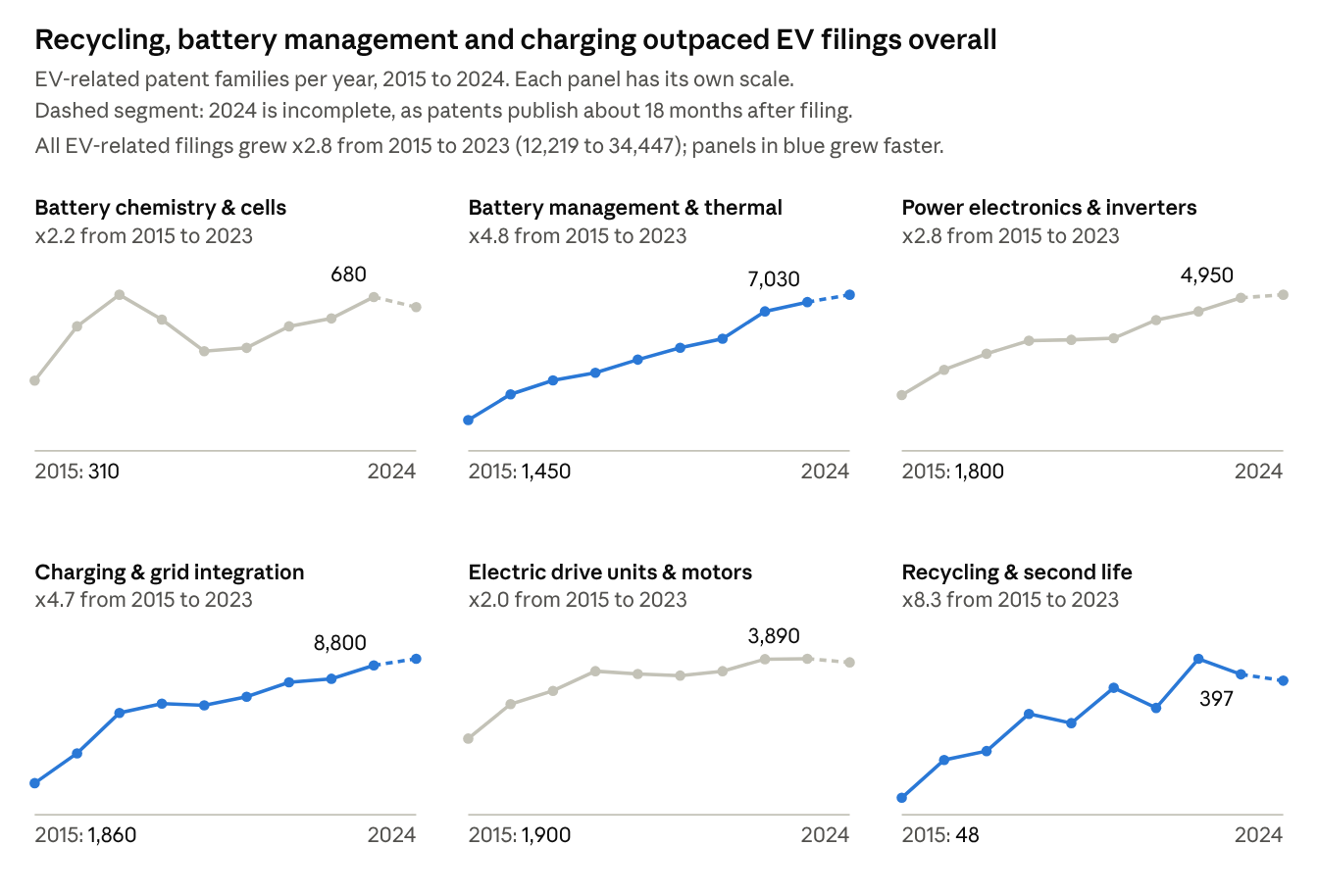
Orbit Intelligence (FamPat) · EV-related patent families, utility-model-only families excluded · 2015–2024 · values read from Orbit charts, approximate
Battery chemistry and cells. Filings peaked in 2017, dipped until 2019 and have risen since, coinciding with the return of LFP cells and growing work on sodium-ion and solid-state designs. This is where cobalt-free and lower-carbon cells are invented.
Battery management and thermal systems. Filings grew almost fivefold, and 2024 is already the highest year despite incomplete data. Longer-lasting batteries mean fewer replacements and less material demand.
Power electronics and inverters. Growth stalled between 2018 and 2020 and picked up again from 2021, as silicon carbide inverters and 800-volt platforms spread. Each efficiency gain means less electricity per kilometre.
Charging and grid integration. The largest area, linked to about a quarter of EV-related filings in 2023. Smart and bidirectional charging is where EVs start to support the grid rather than only draw from it.
Electric drive units and motors. Filings only doubled and have been flat since 2018, a sign of a maturing field where gains are incremental. The open sustainability question is motors with fewer or no rare-earth magnets.
Recycling and second life. The smallest area but the fastest-growing, with about eight times more filings in 2023 than in 2015 and a peak in 2022.
How we counted: patent families (one family is one invention, however many countries it is filed in) with an earliest priority date from 2015 to 2024 and a link to electric vehicles, from Questel Orbit Intelligence (FamPat). Families protected only by utility models are excluded. The six areas overlap, so they do not add up to a total. Battery chemistry and recycling are undercounted, as many such patents never mention a vehicle, and 2024 is incomplete because patents publish about 18 months after filing.
Who’s leading: top filers and surprising entrants
The companies filing the most EV patents worldwide are not the ones holding the most protection in Europe. Across all EV-related families with live protection in Europe, the largest holders are the Volkswagen Group (about 3,850 families across Volkswagen, Audi and Porsche), Ford (about 2,150), BMW (about 1,830), Bosch (about 1,650) and Toyota (about 1,400). The top ten hold 30% of the total.
The picture changes sharply by technology:
| ITechnology area | Largest filer worldwide | Largest holder in Europe | European companies in Europe's top 10 |
|---|---|---|---|
| Battery chemistry and cells | Changsha Juneng New Energy (~190) | CATL (~163) | Umicore, Bosch |
| Battery management and thermal | Hyundai Motor Group (~2,360) | Volkswagen Group (~1,075) | BMW, Porsche, Bosch, Audi, Volkswagen |
| Power electronics and inverters | Hyundai Motor Group (~1,360) | Ford (~442), with Bosch close behind (~428) | Bosch, Porsche, ZF, Volkswagen, BMW |
| Charging and grid integration | Hyundai Motor Group (~1,410) | Volkswagen Group (~940) | BMW, Porsche, Volkswagen, Bosch, Audi |
| Electric drive units and motors | Toyota (~1,260) | Volkswagen Group (~1,215) | BMW, Porsche, Bosch, ZF, Schaeffler, Volkswagen, Audi, Stellantis |
| Recycling and second life | CATL Group (~100) | CATL Group (~49) | Volkswagen, Audi |
Volume is not the same as reach. Changsha Juneng, the largest filer in battery chemistry, is not in Europe’s top ten. State Grid Corporation of China, the second-largest filer in charging worldwide, is absent there too. Hyundai leads battery management by volume but is ninth in Europe. Europe is also more concentrated: in battery chemistry, the top ten hold 43% of European families against 18% worldwide.
Who leads depends on the layer of the vehicle. At the cell level, Asian battery makers lead in Europe as well: CATL and LG Energy Solution are the two largest holders in battery chemistry, and CATL’s recycling arm, Brunp, leads the small European recycling field. At the vehicle level (battery management, charging and motors), European carmakers, Ford and GM hold most of the protection. In power electronics, suppliers such as Bosch and ZF hold as much as the carmakers.
Surprising entrants. Huawei Digital Power holds about as much live European protection in EV power electronics as BMW, and is the only Chinese company in that top ten. Umicore, a Belgian materials company, is the fourth-largest holder in battery chemistry in Europe, ahead of Toyota and Toshiba. In motors, Stellantis joins the German carmakers and suppliers, making it the only area where eight of Europe’s top ten are European.
Company groups are combined where Orbit lists them separately: Volkswagen Group (Volkswagen, Audi, Porsche), Hyundai Motor Group (Hyundai, Kia) and CATL Group (CATL and its Brunp recycling subsidiaries). Figures are approximate, read from Orbit charts.
The geographic picture: Europe, China, US, Japan and Korea, India
China files the most EV patents by far, but Germany is where most of Europe’s EV patent protection sits. Of all EV-related families filed since 2015, 18% have live protection in Europe, and that share varies widely by technology.
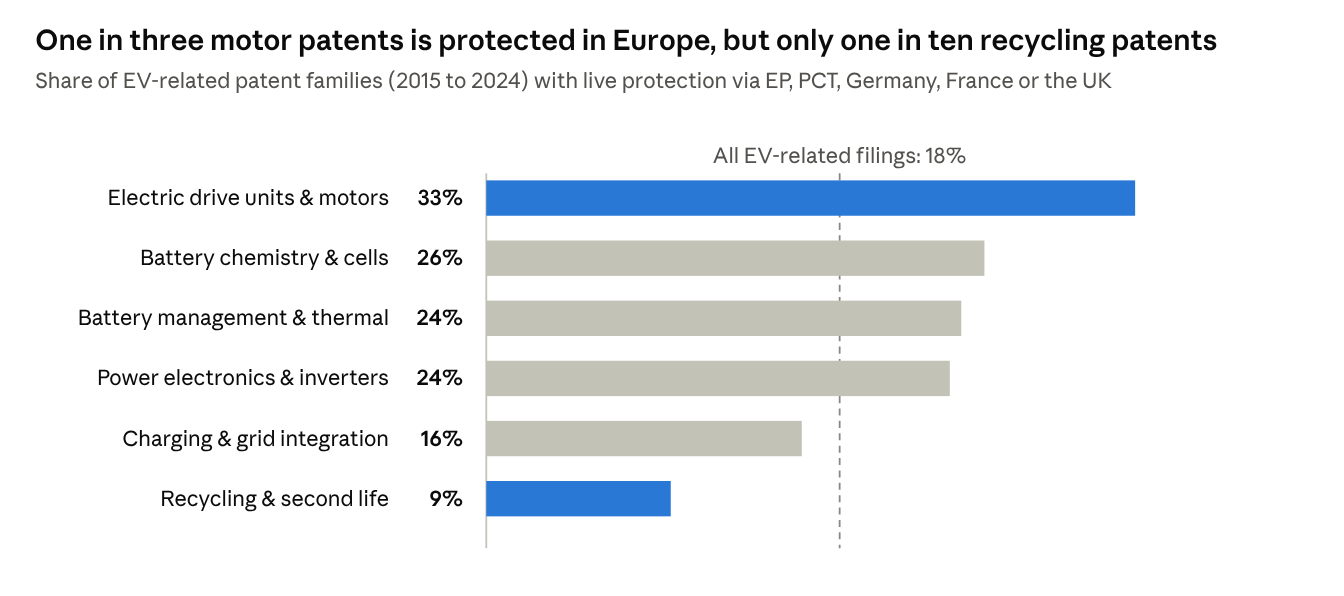
Orbit Intelligence (FamPat) · EV-related patent families with earliest priority 2015–2024, utility-model-only families excluded · counts from Orbit search results
China leads on volume. In battery chemistry, battery management, power electronics and charging, around three-quarters of all families include a Chinese filing. Much of this never leaves China: charging has the highest volume of any area but one of the lowest shares protected in Europe.
Germany is Europe’s centre of gravity. Of the roughly 45,400 EV families with live protection in Europe, about 29,300 (65%) are protected in Germany, more than the 24,418 that include a European Patent Office application. Counting EP and PCT filings alone would have missed more than half of the European protection in motors, where German carmakers and suppliers lead.
Europe-protected families are global portfolios. About half are also filed in China, and about half in the United States. Japan and Korea feature mainly through their largest companies, such as Toyota, Hyundai, Honda and LG Energy Solution.
India appears among the top ten markets in most areas, but at small volumes. Its EV growth is led by two- and three-wheelers, largely outside the car-focused view of this analysis.
“Live protection in Europe” means a granted patent or pending application, at the time of the search, at the European Patent Office, in Germany, France or the UK, or a pending PCT application.
Regulation as an innovation driver
In Europe, regulation is shaping what EV engineers work on as much as customer demand is.
The EU Batteries Regulation. From 18 February 2027, EV batteries sold in the EU need a digital battery passport, and supply-chain due diligence follows in August 2027. Recycled-content documentation comes first, then minimum shares of recycled cobalt, lithium, nickel and lead from 2031, rising again in 2036. Carbon-footprint rules are written in, although their methodology is still being finalised.
The Critical Raw Materials Act. By 2030, the EU aims to extract 10%, process 40% and recycle 25% of its annual consumption of strategic raw materials, with no more than 65% coming from any single non-EU country.
CO₂ standards for new cars. In December 2025 the European Commission proposed cutting the 2035 target from 100% to 90%, with the rest offset through measures such as low-carbon EU steel and alternative fuels. The final terms were still being negotiated in October 2026. Either way, most new cars sold in the EU in 2035 will need to be electric.
Do the rules show up in patents? Recycling filings in 2020 to 2023 were about 70% higher than in 2016 to 2019, after the Batteries Regulation was proposed in December 2020. But more than half of these families are filed in China, and only about one in ten is protected in Europe. EU rules are creating demand for recycling technology faster than European patent protection in the field is being built.
What this means for companies in the space
The findings point to four practical lessons for companies building, supplying or advising in EV technology.
Monitor beyond EP filings. Two-thirds of European EV protection sits in Germany, much of it through national filings. Competitor watching and freedom-to-operate searches based on EP filings alone will miss a large share, especially in motors and drive units.
Do not read volume as threat, or as safety. The largest filers worldwide are often not the ones holding rights in Europe, while newer players such as Huawei Digital Power already do. Landscapes for European decisions should focus on what is enforceable there.
Expect crowded ground at the cell level. In battery chemistry and recycling, Asian battery makers hold most European protection. Automakers moving into new chemistries or in-house cells are entering fields where others already own much of the ground.
Treat recycling as white space with a deadline. With recycled-content rules arriving from 2031 and little recycling IP held in Europe, there is room for European recyclers, OEMs and materials companies to file early, and a risk for those that do not.
The next phase of the EV race will be won on materials and circularity
The first phase of the EV transition was about proving the cars work and that people would buy them. The next is about making them with less carbon, fewer scarce materials and a route back into the supply chain. The patent record shows where that race stands: Europe is strong in electric drive and vehicle-level systems, while cell chemistry and recycling are led from Asia.
There is also a wider link to the energy system. The IEA expects electricity demand from EVs to exceed 1,500 TWh by 2035 under current policies, adding more than 10% to Europe’s total demand. Smart charging and vehicle-to-grid, whose first commercial offers for private owners appeared in 2025, make EVs part of the grid rather than just users of it. That is where EV innovation meets renewable generation and storage, the subject of the next article in this series.
Sources
- Patent data: Questel Orbit Intelligence (FamPat), searches run November 2026; six technology clusters, EV context set and Europe protection sets
- IEA, Global EV Outlook 2026, executive summary (May 2026)
- ACEA, new car registrations 2025 (January 2026)
- electrive, EU-wide new electric car registrations rise by 30% (January 2026)
- Best-selling-cars.com, 2025 Europe BEV sales by country (ACEA data)
- ICCT, Life-cycle greenhouse gas emissions from passenger cars in the EU: 2025 update (July 2025)
- Bank of Finland BOFIT, China retains dominance of critical raw material production (on IEA Global Critical Minerals Outlook 2026) (August 2026)
- Arianee, EU Batteries Regulation: the full timeline from 2023 to 2036
- IEA, European Critical Raw Materials Act
- Council of the EU, car and van CO₂ standards proposal (2026)
- ICCT, the European Commission’s proposed CO₂ standards amendment
- Insurance Journal (Reuters), France, Germany near deal on car emissions (October 2026)